
Water is an essential resource: it is the foundation of everything. Our bodies are made up of about 60–65% water; in some organisms, such as jellyfish, it can account for up to 98% of their body weight.
But water isn’t found “only” where there is life. We also find it where, at first glance, it might seem there is nothing left: in waste. Ignoring it in these cases means leaving a precious asset unused. Because water is a resource that is as indispensable as it is increasingly scarce.
Water as “blue gold”: why this issue can no longer be put off
Water has always been the foundation of human and industrial development; but today it is at the center of a global crisis that calls into question its availability and how it is managed. Amid climate change, population growth, and industrial demands, water is becoming an increasingly scarce—and therefore more valuable—resource: the so-called “blue gold” of the 21st century.
In recent years, water has become a strategic factor for industry (which accounts for a significant share of global water withdrawals—around 20%): seasonal availability, quality, and supply costs all impact production continuity and reputation. At the same time, supply chains and stakeholders are paying increasing attention to consumption, discharge, and reuse. In this context, recovering and reusing water is no longer just about sustainability: it is a concrete lever for operational resilience.
Water scarcity and climate stress: what is changing (Italy/EU)
According to United Nations estimates, approximately 2 billion people live in areas experiencing severe water stress—a situation that is likely to worsen as the population grows and climate change intensifies. In Europe, the European Environment Agency (EEA) reported that in 2023, water scarcity affected 28% of the territory and 32% of the population.
But water scarcity does not affect only regions and communities; it also has a direct impact on the manufacturing sector, as it puts pressure on the availability, quality, and reliability of water supplies.
For this reason, regulatory efforts are being stepped up at multiple levels with the aim of protecting and promoting this marine resource.
Within the EU, this issue is at the heart of environmental policy: a key reference point is the Water Framework Directive (2000/60/EC), which guides efforts to protect and improve the status of water bodies. At the same time, various European initiatives are promoting water efficiency, reuse, and quality, in line with the principles of the circular economy and water resilience.
Globally, agreements and guidelines—such as those issued by the UN and the WHO (World Health Organization)—from strategies for achieving SDG 6 on sustainable water management to the Guidelines for Drinking-water Quality, underscore the importance of sustainable and responsible water management

The direction is clear: maximize value by focusing, wherever possible, on water recovery and on processes that help reduce volumes or separate/concentrate the materials, making management more controllable and efficient.
greater pressure regarding emissions and environmental performance (permits, inspections, KPIs);Tangible impacts on industry and sectors
For companies, paying attention to water issues has three very concrete effects:
- greater cost sensitivity (water, energy, and process utilities);
- greater pressure regarding emissions and environmental performance (permits, inspections, KPIs);Tangible impacts on industry and sectors
- the need to manage fluctuations and peaks related to seasonality and/or production.
In this scenario, “unaccounted-for water” becomes an often-overlooked cost driver. Since waste or organic material can consist of up to 80% water, a significant portion of transportation and storage costs relates to a mass that generates no value and that, in many cases, could be managed differently at the source.
And it’s not just an economic issue: more water means more weight, more handling, and therefore a greater logistical impact—including in terms of emissions. In other words: when you transport very wet waste, you’re often transporting mostly water, paying twice—in direct costs and in environmental impact.
Regulatory pressure is mounting
Within the EU framework, water is increasingly linked to resource efficiency, pollution reduction, and data transparency. For businesses, this means shifting from a “waste disposal” approach to one of “waste recovery.”
In Italy, the primary legal framework remains the Consolidated Environmental Act (Legislative Decree No. 152/2006), which requires prior authorization for all discharges (Art. 124) and sets pollution limits.
Furthermore, at the European level, Regulation (EU) 2020/741 establishes minimum requirements (quality, monitoring, risk management) for the reuse of treated wastewater, particularly in agriculture.
When discussing “water” in an industrial context, it is helpful to distinguish between two aspects:
- wastewater: process water (industrial) and/or stormwater, discharged into the sewer system or a water body;
- liquid waste: liquid or sludge-like substances treated as waste, not as wastewater.
Italy: Discharges, Permits, and Operational Responsibilities
In Italy, the primary reference for water protection and wastewater management is the Legislative Decree 75/2010 152/2006 (Consolidated Environmental Act), which regulates permits, operating conditions, and limit values for wastewater. The result is a comprehensive framework that encourages companies to use water more responsibly: in many cases, recovering and reusing water is not just a “virtuous” choice, but a concrete way to reduce risks, costs, and dependencies downstream.
The key point for management

A key objective is ZLD (Zero Liquid Discharge): an approach that integrates multiple technologies to reduce—and ultimately eliminate—the discharge of liquid effluents to the outside environment.
It is a challenging process that requires careful management and monitoring, but it sends a clear message: water management is no longer just about compliance; it is about operational control and strategy.
What is unaccounted-for water, and why is it a hidden cost?
Many materials processed in industrial settings contain a very high water content: sludge, food waste, process byproducts, digested slurry, or wet organic waste. Unless measures are taken upstream, that water content is transported and managed as part of the waste.
Hence the concept of “unaccounted-for water”: a resource present in the waste stream that ends up being an invisible burden in terms of weight, volume, and cost. In some types of waste, moisture content can reach up to 80%: this means that a significant portion of what companies pay for logistics and management is not “material,” but water.
Costs: logistics, warehousing, third-party management
Let’s imagine 1,000 tons of waste per year, 80% of which is water: this is equivalent to transporting 800 tons of water per year along with the waste. If the volume of water transported is reduced by even just 25%, the number of trips, storage space, and operational variability all decrease. The benefit is not only economic: less transportation also means fewer indirect emissions and reduced exposure to operational challenges such as odors, leachate, and emergency situations.
In short, recovering (or simply reducing) the “hidden” water in materials offers benefits on multiple levels: environmental, logistical, operational, and, increasingly, strategic as well.
Emissions as a measurable side effect
Every ton avoided reduces logistics-related emissions. This is why reducing volumes aligns with decarbonization goals and the growing demand for transparency throughout the supply chain: less unnecessary mass being moved simply means less impact to report.
Compliance and Traceability: When Management Becomes a Reputational Risk
The push toward environmental sustainability and waste reduction can no longer be treated as a “side issue”: customers, supply chains, and stakeholders expect transparency and accountability. Today, it is not enough to simply comply with regulations; companies must be able to demonstrate this with verifiable evidence.
In many industries, a good environmental reputation is a market requirement.
There are many technical solutions available, but only a thorough assessment will allow you to choose the most suitable strategy; this is why it is helpful to consult experts.
Wastewater Recovery: From Waste to a Circular Resource Through the Waste-to-Value Approach
The word “waste” carries a negative connotation, but it often refers to a stream of materials that has not yet been processed or managed. The waste-to-value approach starts here: it does not mean recovering everything indiscriminately, but rather choosing where to transform a cost into a more manageable stream (reusable water, concentrated or dry material, and, where applicable, recoverable outputs).

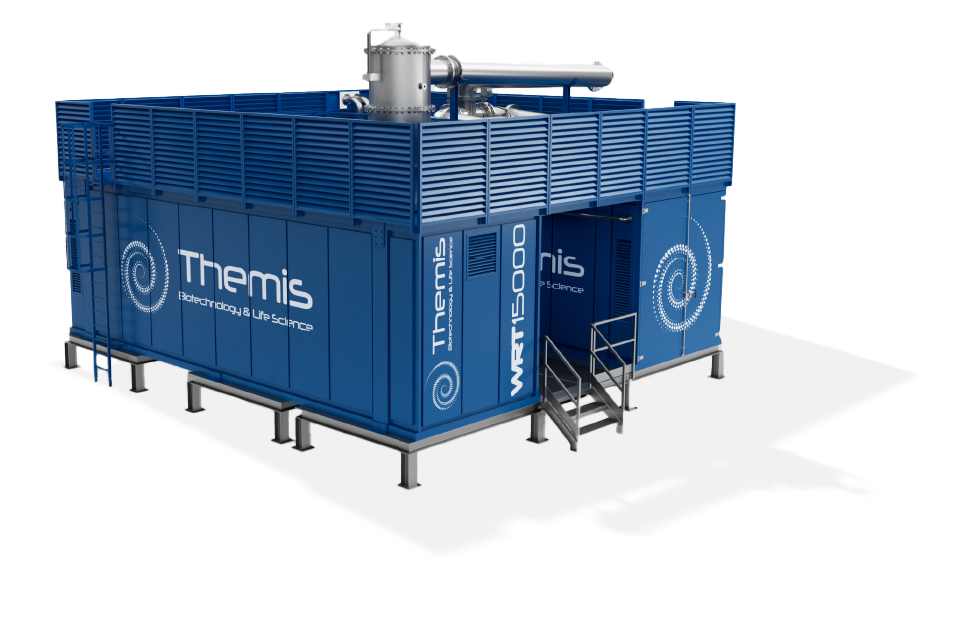
This is where Themis comes in: the company develops tailor-made solutions and processing plants in line with the principles of the circular economy, designed to handle complex materials and meet specific plant objectives. One example is Themis WRT, a technology dedicated to volume reduction and water recovery from sludge, wastewater, and liquid or high-moisture waste, transforming the material into a solid fraction and distilled water.
Recovered distilled water can also offer tangible economic and operational benefits. Where quality standards and permits allow, it can be reused internally (for example, for cleaning, sanitation, replenishment, or non-critical applications), recirculated into the production cycle, or used for technical purposes, thereby reducing water withdrawals from the municipal supply or wells. This means cutting costs associated with water supply and, often, also reducing the volumes to be discharged and the related treatment, transportation, or disposal costs.
This approach can support a path toward ZLD (Zero Liquid Discharge): not as a slogan, but as a technical strategy based on data, the quality of the reclaimed water, and integration with the production process.
Why personalization matters
There are various technologies for water recovery and reuse, but there is no “one-size-fits-all” solution. Every facility has different operating conditions, plant constraints, reuse objectives, and specific regulatory requirements. This is why a thorough technical study is necessary: only by integrating technologies in a way that is consistent with the process, utilities, and quality requirements can a system be achieved that is truly effective and sustainable in the long term.
What a company can do: technical options
With stricter requirements regarding discharges, monitoring, and reporting, water management can no longer be left to crisis mode. For many companies, the priority is now to reduce water usage, stabilize flow rates, and improve control over water quality and traceability. Essentially, the technical approaches focus on three key areas.

Volume reduction
Separation and dewatering processes to reduce the volume of material handled and stabilize the flow: pressing, centrifugation, filtration, thickening, etc. These are often the first step because they immediately reduce logistics costs and prepare the matrix for any subsequent treatments.
Water Recovery
When the goal is to recover water and improve quality control, technologies such as WRT or distillation/evaporation processes are considered. The choice depends on the composition of the feedstock, the reuse objective, available energy, and output management.
Output utilization: solids, nutrients, energy
In some cases, concentrates or dehydrated solids can be sent for recovery or reuse. Here, quality requirements, intended use, permits, and—when it comes to materials—the pathways related to byproducts or end-of-waste status become critical factors.
Recovering uncollected water means gaining a competitive advantage
Water is essential for life and for production processes. But today it is becoming increasingly scarce and is therefore the focus of growing regulatory and environmental pressure.
In this context, innovating and implementing integrated solutions for water treatment, recovery, and reuse represents a powerful driver of tangible transformation. Companies that succeed in combining operational efficiency, sustainability, and responsibility will be able to access new markets, enhance their reputation, and effectively address the challenges posed by climate change and resource scarcity.