
A well-done energy audit can become much more than just a formality: it is the step that allows a company to understand where energy is being ‘lost’, especially when the most impactful processes are wastewater treatment and waste management. In these departments, energy is not only consumed by the machinery itself, but also by everything that revolves around it: volume handling, pumping, storage, discontinuous cycles and operational management.
What is an energy audit and why is it really necessary?
An energy diagnosis (or energy audit) is a structured analysis of the energy consumption and performance of a company or specific processes.
In Italy, energy audits are mandatory every four years for many industrial entities, particularly large companies and energy-intensive companies (i.e. those with high consumption and specific requirements), in accordance with the provisions of the Legislative Decree 75/2010 102/2014 and ENEA’s operational guidelines. In these cases, the audit is initially a compliance requirement, but it can become a competitive advantage if it is designed to generate concrete and measurable actions.
The objective of the audit is not to produce a report ‘to be filed away,’ but to build a decision-making basis consisting of baselines, indicators (KPIs) and a list of priority actions. In practice, it must answer three simple questions:
- Where do we consume the most energy (lines, utilities, departments)?
- When does consumption occur (peaks, cycles, seasonality, shifts)?
- Why does this occur (matrix variability, setpoints, inefficiencies, bottlenecks)?
This approach is particularly useful because it allows energy and operations to be linked: given the same level of production, what conditions cause consumption and management complexity to ‘skyrocket’?
What should emerge from the audit
To turn the energy audit into an investment, the audit must provide clarity and priorities, not just a final document. In particular, it should enable you to:
- Understanding how you really consume energy: not just ‘how much’, but at what times, with what patterns and with what variables (shifts, loads, seasonality, downtime, settings).
- Identify critical points: areas where even small changes can generate tangible benefits (recurring waste, operational inefficiencies, deviations from normality).
- Define a replicable working method: essential KPIs, prioritisation criteria and an approach that the company can reuse over time, instead of starting from scratch every time a deadline approaches.
- Translating analysis into action: a list of reasoned interventions (managerial and technical), organised by impact and feasibility, with indications on what to do ‘immediately’ and what to evaluate as a project.
- Set up results verification: a simple way to check whether actions are working (minimal monitoring, internal accountability, review frequency).
If these elements are present, the audit ceases to be an obligation and becomes a lever for improving efficiency, operational continuity and cost control over time.
Waste treatment: this is where energy is hidden
When it comes to consumption, it is easy to think that the only energy to keep an eye on is that of the main machinery: the largest engine, the most energy-intensive line or the plant that operates 24 hours a day. In reality, a significant portion of energy costs arise in less obvious areas, such as those dedicated to waste management and treatment: operational routines, material transfers, utilities that remain active longer than necessary, cycles that are lengthened due to process instability, and organisational choices that seem neutral but generate inefficiency every day.
In waste treatment, ‘invisible’ energy is often concentrated in three areas:
- The price of volumes
Treating and moving large volumes of water or waste means activating pumps, transfers, recirculation and storage management more often. The audit should make this link clear: how much energy are we spending to manage volumes that, technically, we could reduce? - Process stability
When the matrix varies, the process can become less predictable: cycles lengthen, operational corrections increase and ‘queues’ accumulate. Here too, energy diagnosis is useful because it correlates variability and consumption. - Thermal energy and recovery
Many plants already have thermal carriers or recoverable heat sources available. A well-designed diagnosis helps to understand if and where thermal integration can reduce waste without introducing unnecessary complexity.
When does it make sense to evaluate a technology such as Themis WRT?
If the audit shows that waste treatment accounts for a significant portion of consumption (direct and indirect), then the assessment is not only about ‘how much a machine consumes,’ but also how the system changes: volumes, logistics, operational continuity, and output management.
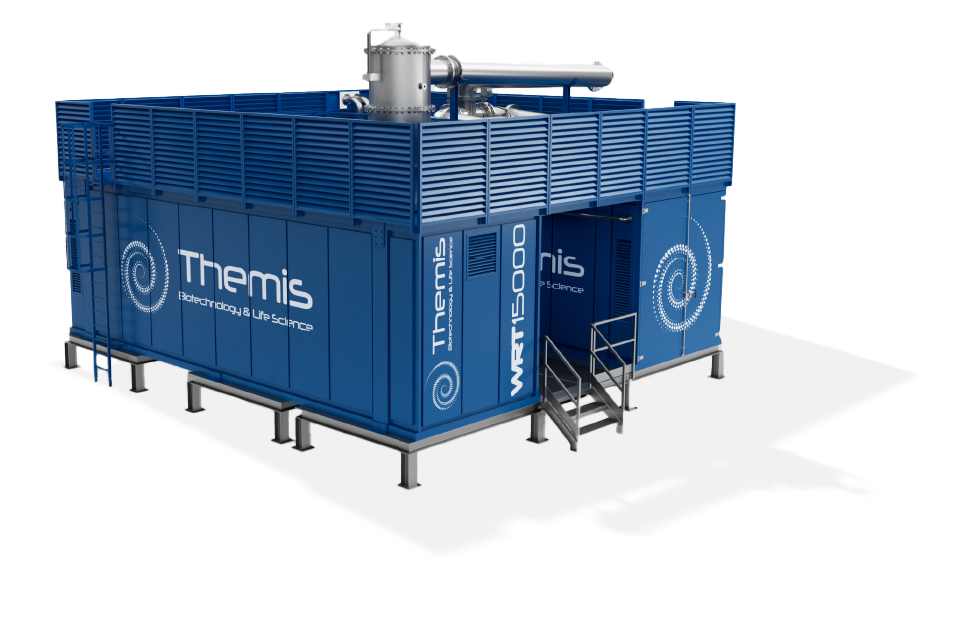
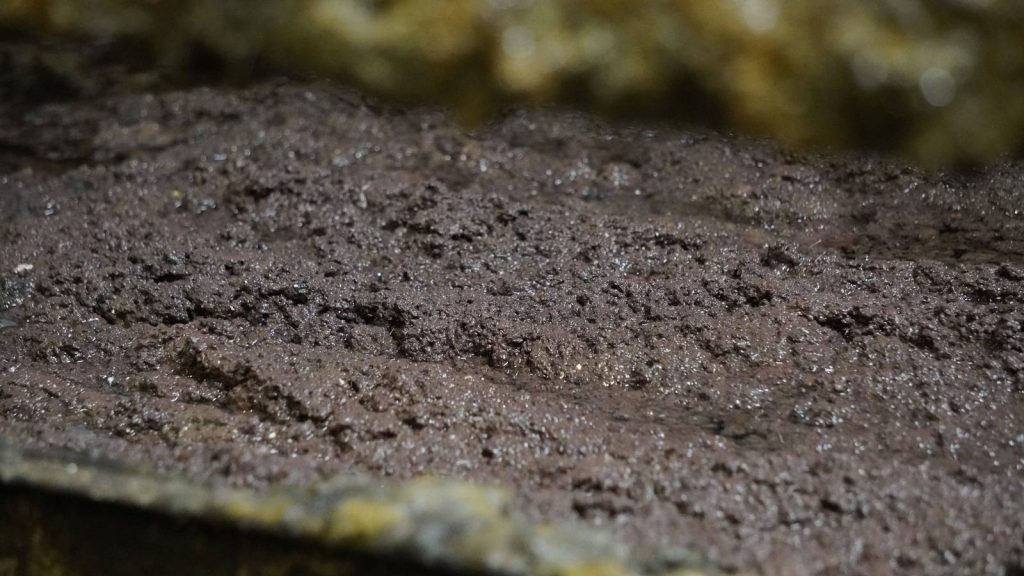
In this context, Themis offers the WRT (Waste Recovery Technology) machine as a solution for dehydrating and transforming waste into distilled water and dry granulated material. Furthermore, with the addition of enzymes, it is possible to enhance the final granulate to create new business opportunities.
What are the significant advantages?
- Reduction and simplification of management: working with a drier output and distilled water can make storage and handling more manageable (a key issue when the ‘weight’ is in the volumes).
- Possible integration with existing utilities: the documentation indicates a possible connection to utilities already present in the plant, which is useful when the energy audit highlights opportunities for integration or energy recovery.
- Focus on low temperatures and available heat carriers: Themis materials describe low-temperature operation and the possibility of exploiting heat carriers already available in the plant, with the aim of reducing waste and operating costs (to be verified on a case-by-case basis during diagnosis).
The key question to bring to the diagnosis
To make the audit useful and actionable, we need to ask ourselves a specific question: what is the total energy cost of our waste management?
If the answer highlights that the problem is structural, then the audit becomes the basis for evaluating technological solutions (such as WRT) with clear criteria: KPIs, scope, plant integration and monitoring.